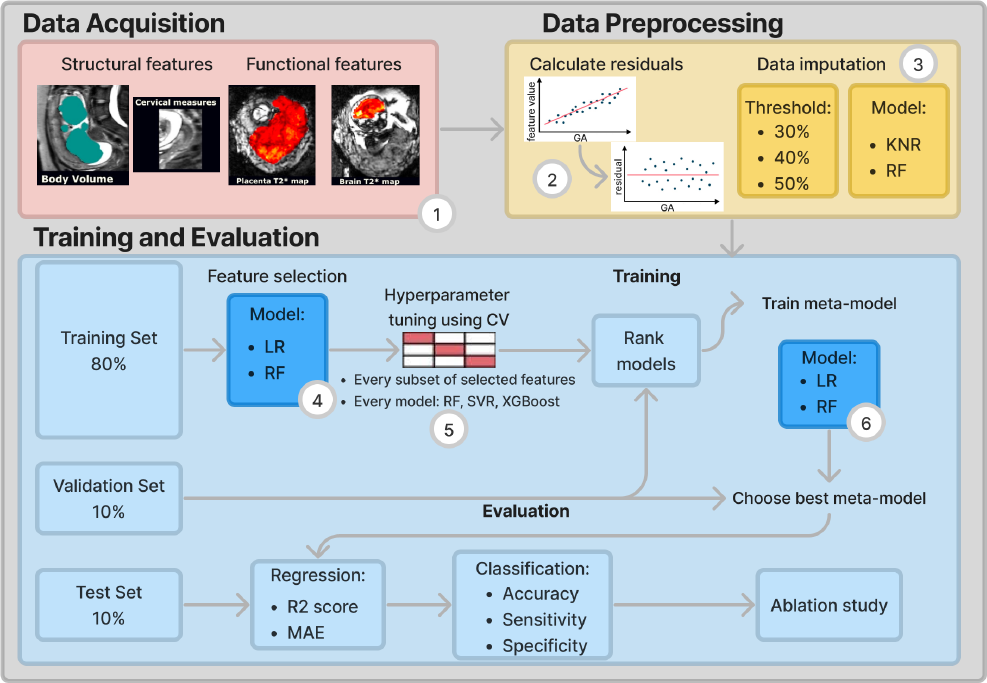
Predicting gestational age at birth in the context of preterm birth from multi-modal fetal MRI
Diego Fajardo-Rojas1,2 , Megan Hall1,3, Daniel Cromb1, Mary A. Rutherford1, Lisa Story1,3, Emma Robinson2, Jana Hutter4,1
1: Early Life Imaging department, King’s College London, London, UK, 2: Biomedical Computing department, King’s College London, London, UK, 3: Women’s Health department, School of Life Course and Population Sciences, King’s College London, London, UK, 4: Institute for Information Processing, Leibniz University Hannover, Hannover, Germany
Publication date: 2026/06/05
https://doi.org/10.59275/j.melba.2026-f34b
Abstract
Preterm birth is associated with significant mortality and a risk for lifelong morbidity. The complex multifactorial aetiology hampers accurate prediction and thus optimal care. A pipeline consisting of bespoke machine learning methods for data imputation, feature selection, and regression models to predict gestational age (GA) at birth was developed and evaluated from comprehensive multi-modal morphological and functional fetal MRI data from 333 control cases and 93 preterm birth cases. The GA at birth predictions were classified into term and preterm categories and their accuracy, sensitivity, and speci- ficity were reported. An ablation study was performed to further validate the design of the pipeline. Performance was evaluated using stratified 10-fold cross-validation. The pipeline achieves an R2 score of 0.13 and a mean absolute error of 2.74 weeks. It also achieves a 0.77 accuracy, 0.59 sensitivity, and 0.82 specificity across folds. The predom- inant features selected by the pipeline include cervical length and statistics derived from placental T2* values. The confluence of fast, motion-robust and multi-modal fetal MRI techniques and machine learning prediction allowed the prediction of the gestation at birth. This information is essential for any pregnancy. To the best of our knowledge, preterm birth had only been addressed as a classification problem in the literature. There- fore, this work provides a proof of concept. Future work will increase the cohort size to allow for finer stratification within the preterm birth cohort. Our code is available at https://github.com/dfajardorojas/ml-for-preterm-birth-
Keywords
Machine Learning · Preterm Birth · Fetal MRI
Bibtex
@article{melba:2026:013:fajardo-rojas,
    title = "Predicting gestational age at birth in the context of preterm birth from multi-modal fetal MRI",
    author = "Fajardo-Rojas, Diego and Hall, Megan and Cromb, Daniel and Rutherford, Mary A. and Story, Lisa and Robinson, Emma and Hutter, Jana",
    journal = "Machine Learning for Biomedical Imaging",
    volume = "2026",
    issue = "June 2026 issue",
    year = "2026",
    pages = "252--273",
    issn = "2766-905X",
    doi = "https://doi.org/10.59275/j.melba.2026-f34b",
    url = "https://melba-journal.org/2026:013"
}
RIS
TY - JOUR
AU - Fajardo-Rojas, Diego
AU - Hall, Megan
AU - Cromb, Daniel
AU - Rutherford, Mary A.
AU - Story, Lisa
AU - Robinson, Emma
AU - Hutter, Jana
PY - 2026
TI - Predicting gestational age at birth in the context of preterm birth from multi-modal fetal MRI
T2 - Machine Learning for Biomedical Imaging
VL - 2026
IS - June 2026 issue
SP - 252
EP - 273
SN - 2766-905X
DO - https://doi.org/10.59275/j.melba.2026-f34b
UR - https://melba-journal.org/2026:013
ER -