Comparison of Loss Functions for Robust Deep Learning-based Echocardiography Segmentation when Learning with Partially Labelled Data from Multiple Domains
Iman Islam1 , Bram Ruijsink1, Esther Puyol-Antón1, Andrew J. Reader1, Andrew P. King1
1: School of Biomedical Engineering & Imaging Sciences, King’s College London, UK
Publication date: 2026/07/02
https://doi.org/10.59275/j.melba.2026-3bfa
Abstract
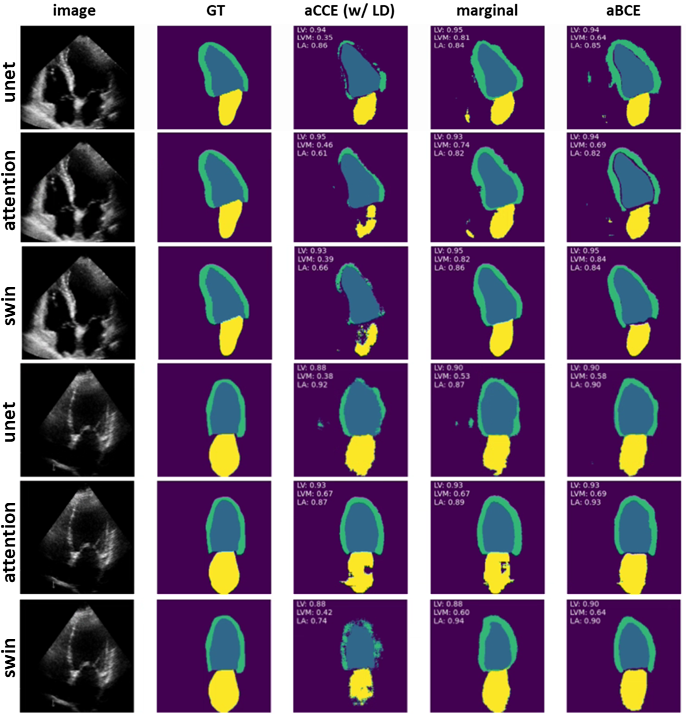
Echocardiography is the first imaging modality used for assessing cardiac function, and accurate segmentation of cardiac structures is essential for deriving biomarkers. However, the development of effective automated segmentation models for multiple cardiac structures is challenged by the difficulty of training on datasets from different sources that are often partially-labelled. This study aims to address this challenge by evaluating the performance of three loss functions - adaptive categorical cross entropy (aCCE) loss, marginal loss, and the adaptive binary cross entropy (aBCE) loss - in handling partially-labelled data. We conduct a comprehensive comparison of these loss functions across multiple scenarios and network architectures: intra-domain and inter-domain tasks, with both single and multiple partial-labels, and varying proportions of fully-labelled to partially-labelled data. Our experiments reveal that all three loss functions exhibit strong performance in intra-domain segmentation tasks, effectively handling label variations within the same domain. For inter-domain tasks, where models are trained on datasets with a domain shift, the aBCE and marginal losses show superior performance when dealing with the case of one label being missing from some training examples. In scenarios involving more than one label being missing, marginal loss outperforms the other methods, demonstrating its robustness in such complex conditions. These results highlight the strengths of each loss function depending on the labelling scenario, emphasizing the importance of selecting the appropriate loss function to optimize model performance. This study represents the first investigation of techniques for handling partially-labelled data from multiple different domains in echocardiography segmentation and provides a comprehensive comparison of loss-based solutions
Keywords
Deep Learning · Image Segmentation · Echocardiography · Partial Labels
Bibtex
@article{melba:2026:022:islam,
    title = "Comparison of Loss Functions for Robust Deep Learning-based Echocardiography Segmentation when Learning with Partially Labelled Data from Multiple Domains",
    author = "Islam, Iman and Ruijsink, Bram and Puyol-Antón, Esther and Reader, Andrew J. and King, Andrew P.",
    journal = "Machine Learning for Biomedical Imaging",
    volume = "2026",
    issue = "July 2026 issue",
    year = "2026",
    pages = "464--480",
    issn = "2766-905X",
    doi = "https://doi.org/10.59275/j.melba.2026-3bfa",
    url = "https://melba-journal.org/2026:022"
}
RIS
TY - JOUR
AU - Islam, Iman
AU - Ruijsink, Bram
AU - Puyol-Antón, Esther
AU - Reader, Andrew J.
AU - King, Andrew P.
PY - 2026
TI - Comparison of Loss Functions for Robust Deep Learning-based Echocardiography Segmentation when Learning with Partially Labelled Data from Multiple Domains
T2 - Machine Learning for Biomedical Imaging
VL - 2026
IS - July 2026 issue
SP - 464
EP - 480
SN - 2766-905X
DO - https://doi.org/10.59275/j.melba.2026-3bfa
UR - https://melba-journal.org/2026:022
ER -