Evaluating Synthetic Data Generation for Domain Generalization in Fetal Brain MRI Segmentation
Vladyslav Zalevskyi1,2,3 , Thomas Sanchez1,2,3, Margaux Roulet1,2, Busra Bulut1,2, Hélène Lajous1,2, Jordina Aviles Verdera4,5, Sara Neves Silva5, Georg Langs6,7,8, Gregor Kasprian7,9, Roxane Licandro6,7,8, Jana Hutter4,5, Hamza Kebiri1,2, Meritxell Bach Cuadra1,2
1: Department of Radiology, Lausanne University Hospital and University of Lausanne (UNIL), Lausanne, Switzerland, 2: CIBM Center for Biomedical Imaging, Lausanne, Switzerland, 3: Equal contribution, 4: Institute for Information Processing, Leibniz University Hannover, Hannover, Germany, 5: Department of Biomedical Engineering, School of Biomedical Engineering & Imaging Sciences, King’s College London, London, United Kingdom, 6: Department of Biomedical Imaging and Image-guided Therapy, Computational Imaging Research Lab (CIR), Medical University of Vienna, Vienna, Austria, 7: Christian Doppler Laboratory for Mathematical Modelling and Simulation of Next-Generation Medical Ultrasound Devices, Medical University of Vienna, Vienna, Austria, 8: Comprehensive Center for Artificial Intelligence in Medicine, Medical University of Vienna, Vienna, Austria, 9: Division of Neuroradiology and Musculoskeletal Radiology, Department of Biomedical Imaging and Image–guided Therapy, Medical University of Vienna, Vienna, Austria
Publication date: 2026/07/01
https://doi.org/10.59275/j.melba.2026-6e4e
Abstract
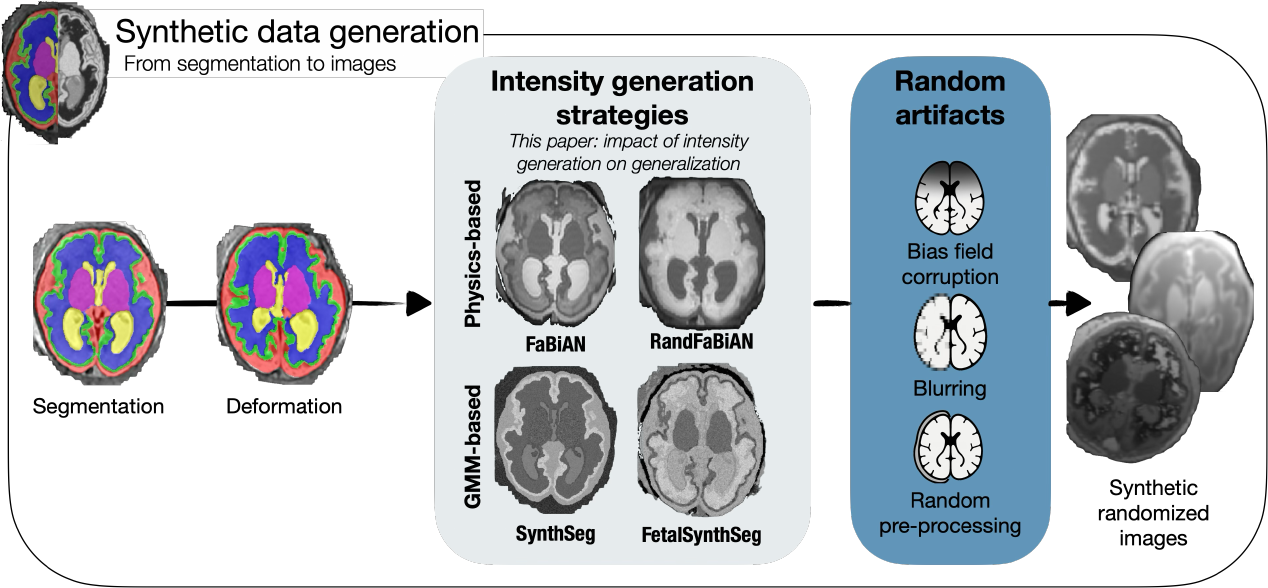
Fetal brain tissue segmentation from magnetic resonance imaging (MRI) is crucial for studying neurodevelopment, but remains challenging due to data heterogeneity and limited annotations. Domain randomization (DR) has recently emerged as a promising strategy for single-source domain generalization by synthesizing training images with randomized artifacts, contrast, and resolution. In this work, we investigate how to maximize the out-of-domain (OOD) generalization of DR-based methods using FetalSynthSeg as a case study. We show that simple Gaussian mixture-based intensity modeling outperforms more complex physics-based simulations and that intensity clustering (subdividing tissue classes by intensity) substantially improves OOD robustness. Evaluated on 348 fetal subjects from four sites spanning 0.55–3T and both T1w and T2w contrasts, FetalSynthSeg reaches state-of-the-art performance on several FeTA 2024 testing datasets (80–85 Dice score) and, for the first time, offers robust segmentation on modalities other than T2w for fetal brain segmentation (80 Dice on dHCP-T1w dataset). Compared with state-of-the-art methods such as BOUNTI, nnU-Net ensemble, and the FeTA 2024 winner, FetalSynthSeg delivers comparable or superior accuracy while maintaining strong robustness across domain shifts. Our code, model weights, and Docker image ready for easy inference are available at https://hub.docker.com/r/vzalevskyi/fetalsynthseg
Keywords
Segmentation · Fetal Brain · MRI · Domain shifts · Synthetic Data · Domain Randomization
Bibtex
@article{melba:2026:023:zalevskyi,
    title = "Evaluating Synthetic Data Generation for Domain Generalization in Fetal Brain MRI Segmentation",
    author = "Zalevskyi, Vladyslav and Sanchez, Thomas and Roulet, Margaux and Bulut, Busra and Lajous, Hélène and Aviles Verdera, Jordina and Neves Silva, Sara and Langs, Georg and Kasprian, Gregor and Licandro, Roxane and Hutter, Jana and Kebiri, Hamza and Bach Cuadra, Meritxell",
    journal = "Machine Learning for Biomedical Imaging",
    volume = "2026",
    issue = "July 2026 issue",
    year = "2026",
    pages = "482--506",
    issn = "2766-905X",
    doi = "https://doi.org/10.59275/j.melba.2026-6e4e",
    url = "https://melba-journal.org/2026:023"
}
RIS
TY - JOUR
AU - Zalevskyi, Vladyslav
AU - Sanchez, Thomas
AU - Roulet, Margaux
AU - Bulut, Busra
AU - Lajous, Hélène
AU - Aviles Verdera, Jordina
AU - Neves Silva, Sara
AU - Langs, Georg
AU - Kasprian, Gregor
AU - Licandro, Roxane
AU - Hutter, Jana
AU - Kebiri, Hamza
AU - Bach Cuadra, Meritxell
PY - 2026
TI - Evaluating Synthetic Data Generation for Domain Generalization in Fetal Brain MRI Segmentation
T2 - Machine Learning for Biomedical Imaging
VL - 2026
IS - July 2026 issue
SP - 482
EP - 506
SN - 2766-905X
DO - https://doi.org/10.59275/j.melba.2026-6e4e
UR - https://melba-journal.org/2026:023
ER -