Evaluation of Uncertainty-Aware Multi-Software Ensembles for Hippocampal Segmentation
Gabriel Oliveira-Stahl1,2, Anna Schroder1,2, James Moggridge2,3, Hamza A. Salhab2, Caroline Micallef2, Josephine Barnes4, M. Jorge Cardoso5, Carole H. Sudre*1,6,5, Matthew Grech-Sollars*1,2
1: Hawkes Institute, Department of Computer Science, University College London, UK, 2: Lysholm Department of Neuroradiology, National Hospital for Neurology and Neurosurgery, University College London Hospitals NHS Foundation Trust, London, UK, 3: Department of Brain Repair and Rehabilitation, UCL Institute of Neurology, University College London, UK, 4: Dementia Research Centre, University College London, UK, 5: School of Biomedical Engineering & Imaging Sciences, King’s College London, UK, 6: Unit for Lifelong Health and Ageing, Department of Population Science and Experimental Medicine, University College London, UK
Publication date: 2026/09/24
https://doi.org/10.59275/j.melba.2026-e77b
Abstract
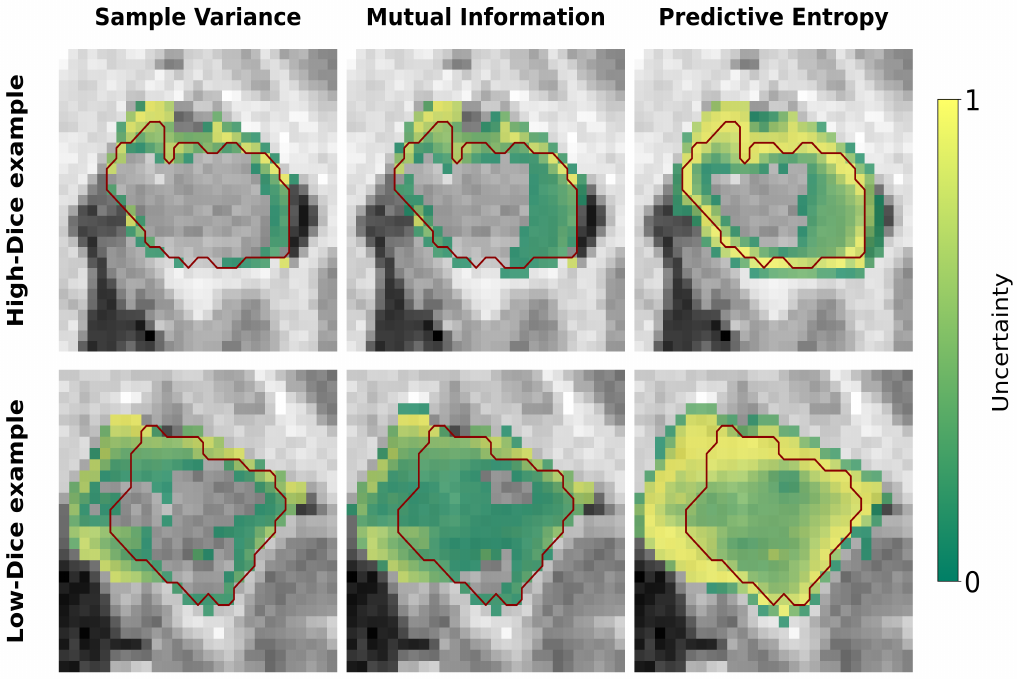
Accurate hippocampal segmentation can be a useful tool for diagnosing and monitoring neurological conditions such as Alzheimer’s disease and epilepsy. While numerous automated segmentation methods exist, their clinical adoption remains limited. Reliable uncertainty assessment can enhance trust and facilitate clinical translation. This study evaluates ensembles of five heterogeneous hippocampal segmentation methods — InnerEye, ASHS, FastSurfer, HippoSeg, and FreeSurfer — across two dementia datasets and one epilepsy dataset. The sub-ensemble containing InnerEye, FastSurfer, and HippoSeg emerged as both accurate and efficient, highlighting the feasibility of balancing computational cost and performance. Additionally, ensemble-derived uncertainty quantification with sample variance, mutual information, and predictive entropy is shown to reduce inaccurate segmentations by flagging low-confidence cases, potentially providing a mechanism for automatically escalating ambiguous cases for expert assessment. Lastly, this study explores the downstream clinical utility of ensemble-derived uncertainty, finding a significant correlation with motion artefact severity and a modest contribution to Alzheimer’s disease classification.
Keywords
Uncertainty estimation · Ensemble · Hippocampal segmentation · Carbon footprint · Alzheimer’s disease
Bibtex
@article{melba:2026:030:oliveira-stahl,
    title = "Evaluation of Uncertainty-Aware Multi-Software Ensembles for Hippocampal Segmentation",
    author = "Oliveira-Stahl, Gabriel and Schroder, Anna and Moggridge, James and Salhab, Hamza A. and Micallef, Caroline and Barnes, Josephine and Cardoso, M. Jorge and Sudre*, Carole H. and Grech-Sollars*, Matthew",
    journal = "Machine Learning for Biomedical Imaging",
    volume = "2026",
    issue = "UNSURE2025 special issue",
    year = "2026",
    pages = "615--633",
    issn = "2766-905X",
    doi = "https://doi.org/10.59275/j.melba.2026-e77b",
    url = "https://melba-journal.org/2026:030"
}
RIS
TY - JOUR
AU - Oliveira-Stahl, Gabriel
AU - Schroder, Anna
AU - Moggridge, James
AU - Salhab, Hamza A.
AU - Micallef, Caroline
AU - Barnes, Josephine
AU - Cardoso, M. Jorge
AU - Sudre*, Carole H.
AU - Grech-Sollars*, Matthew
PY - 2026
TI - Evaluation of Uncertainty-Aware Multi-Software Ensembles for Hippocampal Segmentation
T2 - Machine Learning for Biomedical Imaging
VL - 2026
IS - UNSURE2025 special issue
SP - 615
EP - 633
SN - 2766-905X
DO - https://doi.org/10.59275/j.melba.2026-e77b
UR - https://melba-journal.org/2026:030
ER -