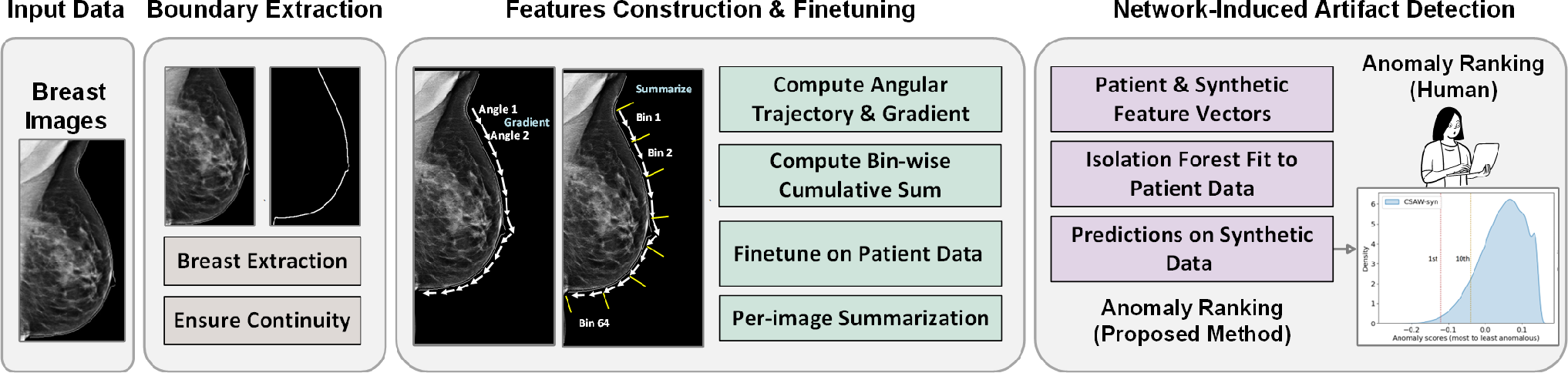
Knowledge-based anomaly detection for identifying network-induced shape artifacts
Rucha Deshpande1, Tahsin Rahman1, Miguel Lago1, Adarsh Subbaswamy1, Jana G. Delfino1, Ghada Zamzmi1, Elim Thompson1, Aldo Badano1, Seyed Kahaki1
1: Division of Imaging, Diagnostics, and Software Reliability, Office of Science and Engineering Laboratories, Center for Devices and Radiological Health, U. S. Food and Drug Administration, USA
Publication date: 2026/09/29
https://doi.org/10.59275/j.melba.2026-eb33
Abstract
Synthetic data provides a promising approach to address data scarcity for training machine learning models; however, adoption without proper quality assessments may introduce artifacts, distortions, and unrealistic features that compromise model performance and downstream utility for medical imaging research and evaluation purposes. This work introduces a novel knowledge-based anomaly detection method for detecting network-induced shape artifacts in synthetic images. The introduced method utilizes a two-stage approach comprising (i) a novel feature extractor that constructs a specialized feature space by analyzing the per-image distribution of angle gradients along anatomical boundaries, and (ii) an isolation forest-based anomaly detector. This representation captures local shape variations while maintaining global anatomical correspondence regardless of size differences. The isolation forest is trained on patient data to learn normal anatomical shape characteristics and assigns anomaly scores to synthetic images. This method may be used to detect anatomically unrealistic images irrespective of the generative model used and provides interpretability through its knowledge-based design. We demonstrate the effectiveness of the method for identifying network-induced shape artifacts in two synthetic mammography datasets generated by different architectures: a latent diffusion model and StyleGAN2, trained on CSAW-M and VinDr-Mammo patient datasets respectively. Quantitative evaluation shows that the method successfully concentrates artifacts in the most anomalous partition (1st percentile), with AUC values of 0.97 (CSAW-syn) and 0.91 (VMLO-syn). Comparison with anomaly detection based on other standard shape descriptors was used to demonstrate the superiority of the proposed method at isolating subtle shape artifacts along with extreme ones. In addition, a reader study involving three imaging scientists confirmed that images identified by the method as containing network-induced shape artifacts were also flagged by human readers with mean agreement rates of 66% (CSAW-syn) and 68% (VMLO-syn) for the most anomalous partition, approximately 1.5-2 times higher than the least anomalous partition. Kendall-Tau correlations between algorithmic and human rankings were 0.45 and 0.43 for the two datasets, indicating reasonable agreement despite the challenging nature of subtle artifact detection. This method is a step forward in supporting quality assurance practices for synthetic data in research and development contexts, as it allows developers to evaluate synthetic images for known anatomic constraints and pinpoint and address specific issues to improve the overall quality of a synthetic dataset. This method is presented as a research tool for synthetic image quality evaluation. Its application in clinical or regulatory decision-making contexts would require additional validation appropriate to the intended use.
Keywords
Network-induced shape artifacts · digital mammography · shape analysis · anomaly detection · synthetic data evaluation
Bibtex
@article{melba:2026:034:deshpande,
    title = "Knowledge-based anomaly detection for identifying network-induced shape artifacts",
    author = "Deshpande, Rucha and Rahman, Tahsin and Lago, Miguel and Subbaswamy, Adarsh and Delfino, Jana G. and Zamzmi, Ghada and Thompson, Elim and Badano, Aldo and Kahaki, Seyed",
    journal = "Machine Learning for Biomedical Imaging",
    volume = "2026",
    issue = "MIDL 2025 special issue",
    year = "2026",
    pages = "701--720",
    issn = "2766-905X",
    doi = "https://doi.org/10.59275/j.melba.2026-eb33",
    url = "https://melba-journal.org/2026:034"
}
RIS
TY - JOUR
AU - Deshpande, Rucha
AU - Rahman, Tahsin
AU - Lago, Miguel
AU - Subbaswamy, Adarsh
AU - Delfino, Jana G.
AU - Zamzmi, Ghada
AU - Thompson, Elim
AU - Badano, Aldo
AU - Kahaki, Seyed
PY - 2026
TI - Knowledge-based anomaly detection for identifying network-induced shape artifacts
T2 - Machine Learning for Biomedical Imaging
VL - 2026
IS - MIDL 2025 special issue
SP - 701
EP - 720
SN - 2766-905X
DO - https://doi.org/10.59275/j.melba.2026-eb33
UR - https://melba-journal.org/2026:034
ER -