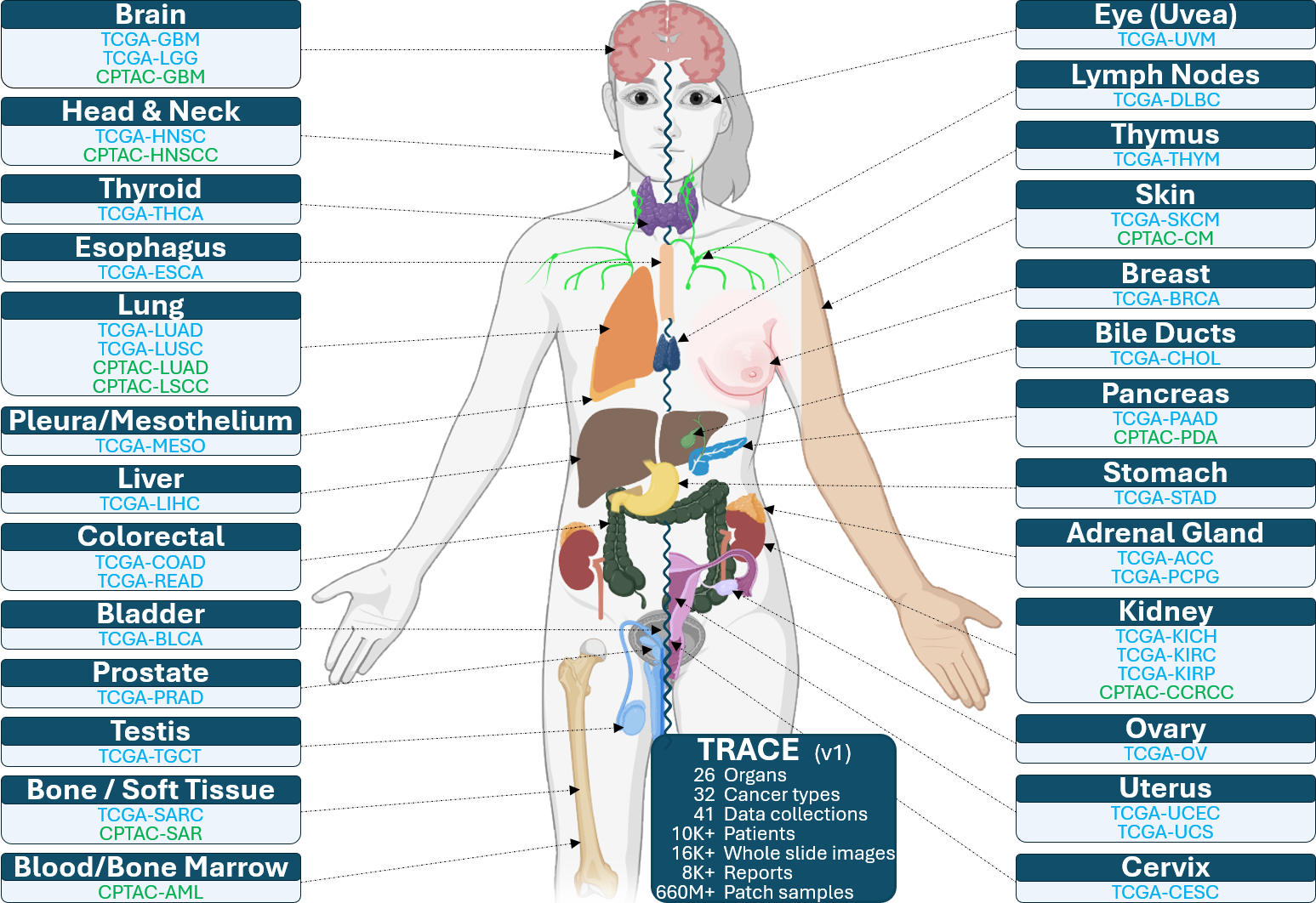
TRACE: Tissue and Report Atlas of Computational Embeddings
Siddhesh Thakur1,2, Sanket Kachole1,2, Spyridon Bakas1,2,3,4
1: Division of Computational Pathology, Department of Pathology and Laboratory Medicine, Indiana University School of Medicine, Indianapolis, IN, USA, 2: Indiana University Simon Comprehensive Cancer Center, Indianapolis, IN, USA, 3: Departments of Biostatistics and Health Data Science; Radiology and Imaging Sciences; Neurological Surgery, Indiana University School of Medicine, Indianapolis, IN, USA, 4: Department of Computer Science, Luddy School of Informatics, Computing, and Engineering, Indiana University, Indianapolis, IN, USA
Publication date: 2026/09/21
https://doi.org/10.59275/j.melba.2026-c671
Abstract
Computational pathology (CompPath) workflows increasingly rely on computational embeddings from digitized hema- toxylin and eosin (H&E) whole-slide images (WSIs). Generating such embeddings reproducibly and at scale requires large image transfers, magnification-aware tiling, model-specific preprocessing, versioned software environments, and substantial graphics processing unit (GPU) inference time. Here, we introduce the Tissue and Report Atlas of Computational Embeddings (TRACE), as a comprehensive atlas of standardized, multi-scale, and multi-encoder pathology embeddings to eliminate the repetition of this inference burden and expedite CompPath discoveries. TRACE provides multi-magnification (5×, 10×, 20×) histopathology embeddings from diagnostic H&E WSIs, as well as text embeddings from associated diagnostic clinical reports, at the scale of The Cancer Genome Atlas (TCGA) and the Clinical Proteomic Tumor Analysis Consortium (CPTAC) entire data collections. In favor of promoting reproducible reuse of these embeddings and clinically-relevant analyses, TRACE also offers patient-level related clinical (e.g., demographic, treatment), molecular, computational (e.g., preprocessing parameters, tensor metadata), and model provenance information. Sanity-check computational validation of the provided embeddings confirm disease-relevant signal, enabling researchers to move directly to expedited, fair, and reproducible CompPath studies. TRACE is released with its accompanying code and documentation via HuggingFace: https://huggingface.co/datasets/IUCompPath/TRACE
Keywords
Computational pathology · foundation models · whole-slide images · clinical reports · embeddings · multiple-instance learning · TCGA · CPTAC
Bibtex
@article{melba:2026:041:thakur,
    title = "TRACE: Tissue and Report Atlas of Computational Embeddings",
    author = "Thakur, Siddhesh and Kachole, Sanket and Bakas, Spyridon",
    journal = "Machine Learning for Biomedical Imaging",
    volume = "2026",
    issue = "Special Issue on MICCAI Open Data 2026",
    year = "2026",
    pages = "792--812",
    issn = "2766-905X",
    doi = "https://doi.org/10.59275/j.melba.2026-c671",
    url = "https://melba-journal.org/2026:041"
}
RIS
TY - JOUR
AU - Thakur, Siddhesh
AU - Kachole, Sanket
AU - Bakas, Spyridon
PY - 2026
TI - TRACE: Tissue and Report Atlas of Computational Embeddings
T2 - Machine Learning for Biomedical Imaging
VL - 2026
IS - Special Issue on MICCAI Open Data 2026
SP - 792
EP - 812
SN - 2766-905X
DO - https://doi.org/10.59275/j.melba.2026-c671
UR - https://melba-journal.org/2026:041
ER -